Theory
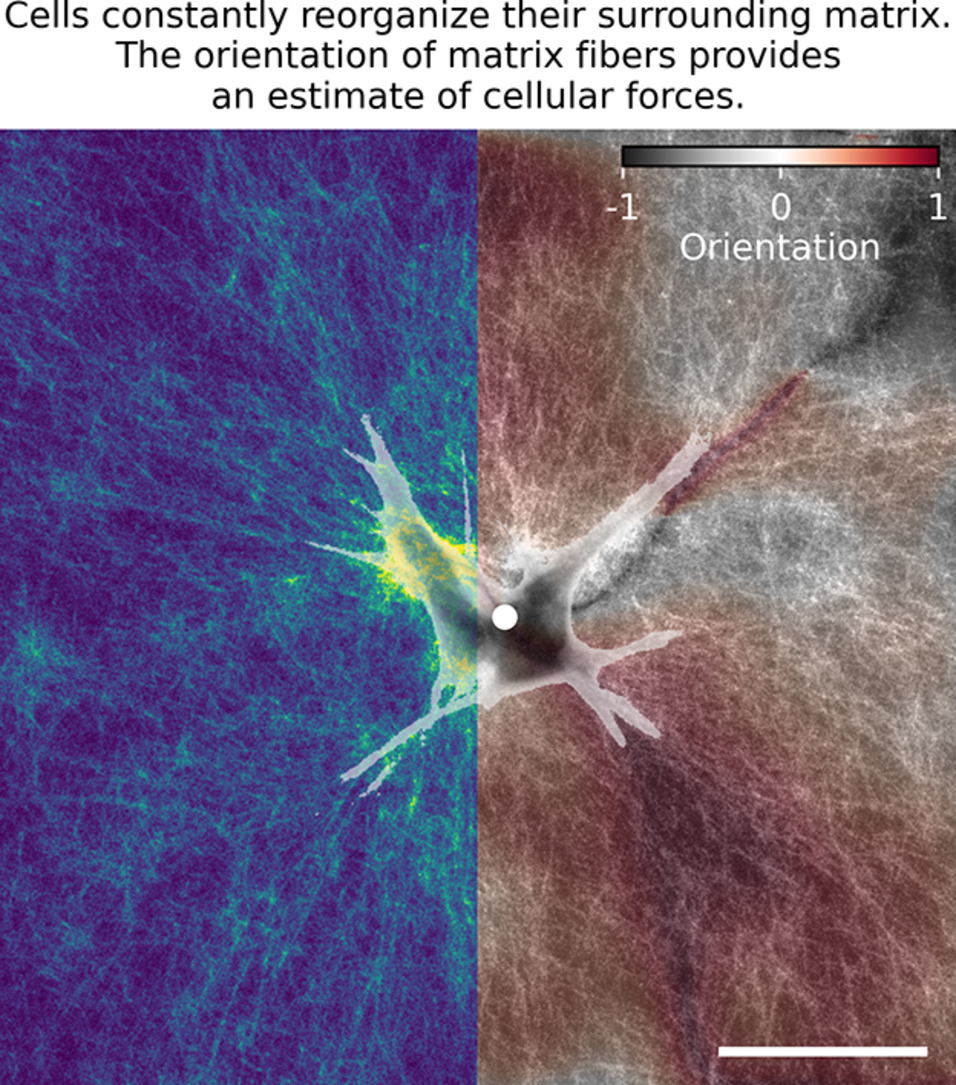
CompactionAnalyzer is a Python package that quantifies the amount of fiber alignment and fiber density around contractile cells embedded in fibrous matrices. These features can serve as proxy measures of contractile force, or can also be used for other applications such as matrix remodeling assessment.
Unlike traditional traction force microscopy (TFM), this method does not rely on rheological characterization of the matrix. Instead, mechanical forces are inferred from the amount of tissue re-modelling and can be compared relatively between conditions, such as drug-treated versus control cells within the same matrix.
Key advantages include:
No material calibration: The method quantifies normalized fiber alignment and density between cells using same isotropic fiber gels.
Broad applicability: Compatible with a variety of biopolymer matrices such as collagen, or fibrin.
Fast imaging & analysis workflow: Typically uses 2D maximum-intensity projections around the cells in 3D gels (instead of full 3D image stacks).
How it works
Z-stacks of the fluorescently labeled cell and the surrounding fibrous matrix are acquired and maximum-intensity projections are generated around the cell surface
The cell area is segmented from the projected cell image
Local fiber alignment is computed using structure tensor analysis on the projected matrix image, and fiber orientations are transformed relative to the radial direction from the cell center.
Fiber density is calculated in concentric zones around the cell and normalized to background levels.
These normalized alignment and density values can be interpreted as relative indicators of contractile force
This approach enables fast and calibration-free quantification of cell-induced matrix remodeling and force output in 3D environments.
Further details are described in:
Publication: Böhringer et al., Fiber alignment in 3D collagen networks as a biophysical marker for cell contractility (2023) DOI: https://doi.org/10.1016/j.matbio.2023.11.004
Github Repository: https://github.com/davidbhr/CompactionAnalyzer