Material Parameters
The material parameters \(k\), \(d_0\), \(\lambda_s\), and \(d_s\) are explained in the section Material.
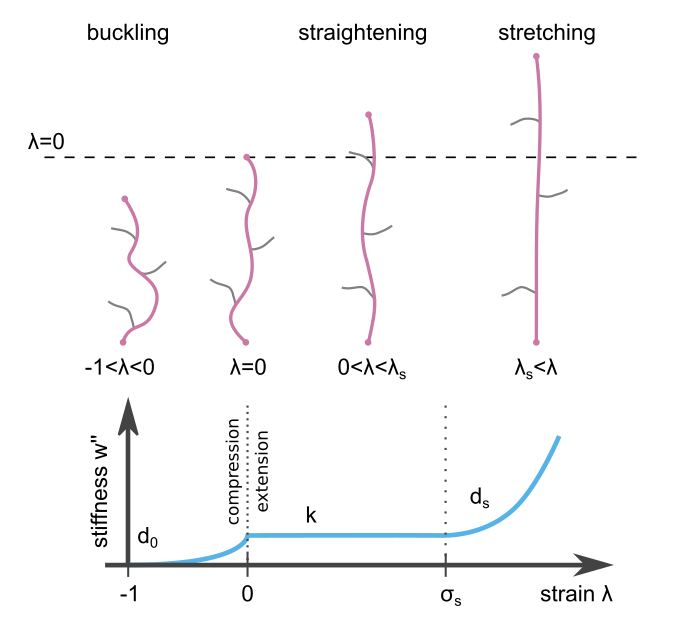
Meaning of the parameters
Parameter |
Meaning |
|---|---|
\(k\) |
Stiffness of the material in the linear regime. |
\(d_0\) |
Decay parameter in the buckling regime. If omitted, the material shows no buckling but a linear response under compression. |
\(\lambda_s\) |
Stretch at which strain stiffening starts. If omitted, the material shows no strain stiffening. |
\(d_s\) |
How strong the strain stiffening is. If omitted, the material shows no strain stiffening. |
Setting only \(k\) and omitting the other three gives a linear material,
which is what LinearMaterial does.
Values used in the examples
These are the parameter sets the bundled examples run with. They are starting points, not reference values for collagen in general: the parameters depend strongly on concentration, batch and polymerisation conditions, so for your own gel they have to be fitted to a rheological measurement or taken from a publication that characterised the same preparation.
Used by |
\(k\) |
\(d_0\) |
\(\lambda_s\) |
\(d_s\) |
Notes |
|---|---|---|---|---|---|
Single cell, organoid and brightfield examples |
6062 |
0.0025 |
0.0804 |
0.034 |
the default in most examples |
Dynamical single cell example (NK cells) |
1449 |
0.0022 |
0.032 |
0.055 |
described in the interface as collagen I, 1.2 mg/ml |
Linear material |
Young’s modulus \(\times\) 6 |
— |
— |
— |
|